


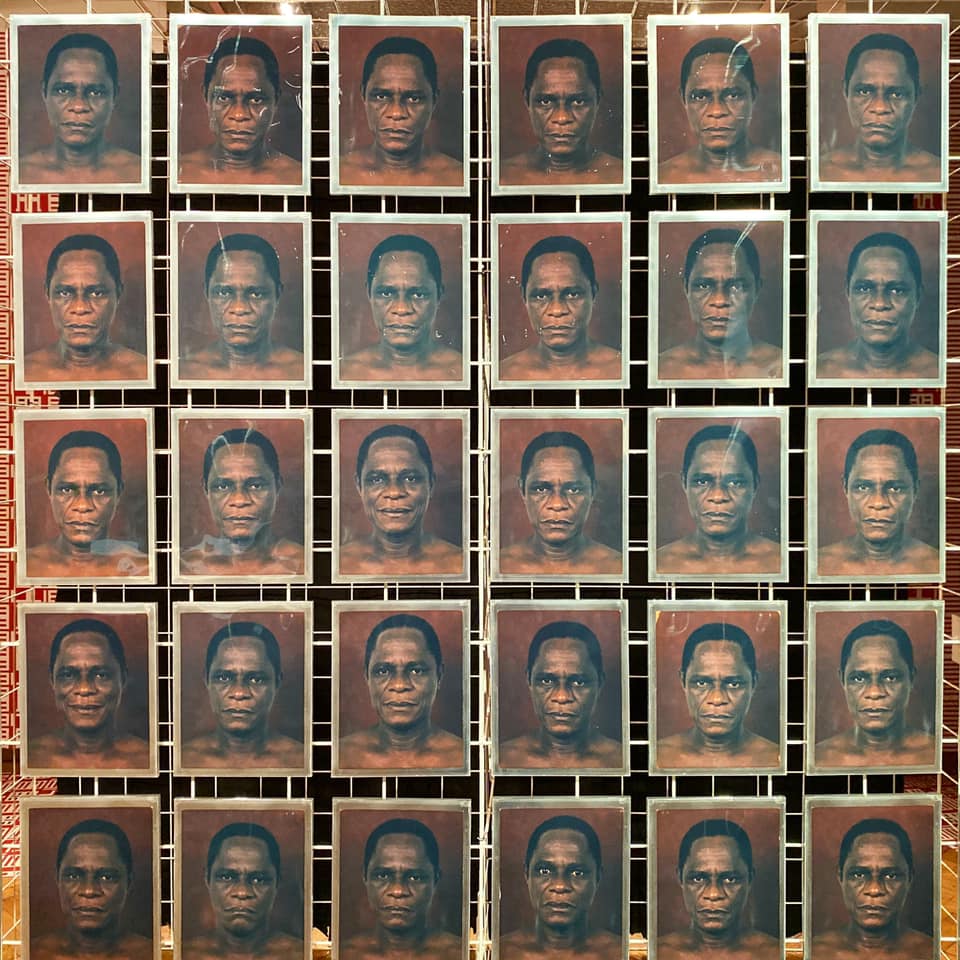

Fosso was born in Kumba, Cameroon, to Nigerian parents.
He grew up in Afikpo, his ancestral home until he had to flee to Bangui in the Central African Republic at the age of thirteen in 1972 in the wake of the Nigerian Civil War. In Bangui he began to work as an assistant photographer when he was twelve, and a year later as a portrait photographer with his own studio in Bangui, ‘Studio Photo Nationale’.
Initially, he made self-portraits to fill up the unused parts of his photographic films. These photographs were destined for his mother, who had stayed behind in Nigeria. The making of self-portraits became an objective on its own for him. Fosso’s style is somewhat comparable with that of Diane Arbus, in that his self-portraits show a glimpse of our own humanity. Arbus’s photography has been said to show that everyone has their own identity, that is to say, what remains when we take away the rest.
In contrast, Fosso’s varying costumes are said to show that identity is determined partly as well by things over which humans lack control.
His work has therefore also been characterized as having disclosure of how humans can in fact create their own identity.